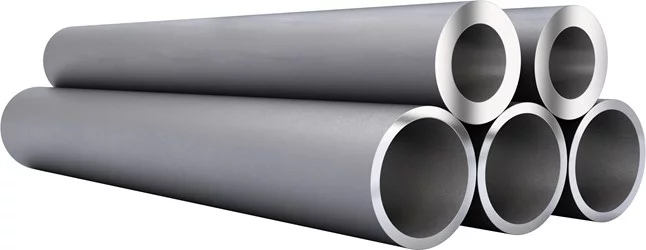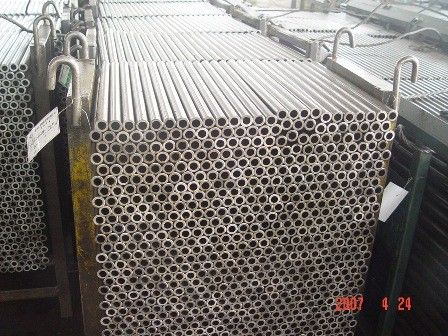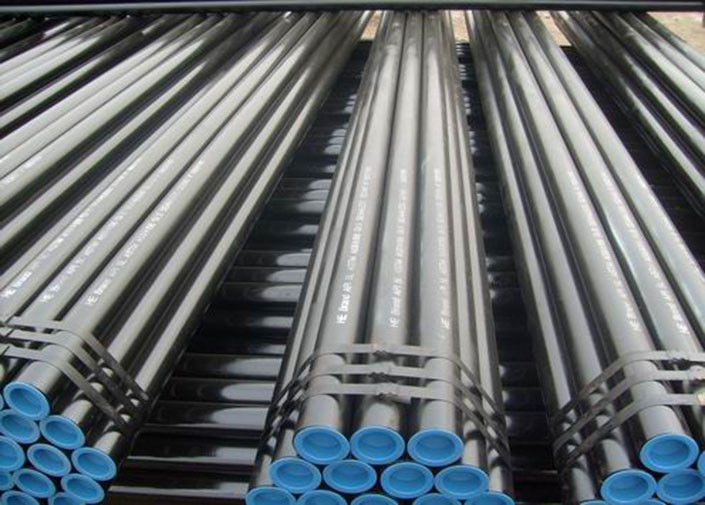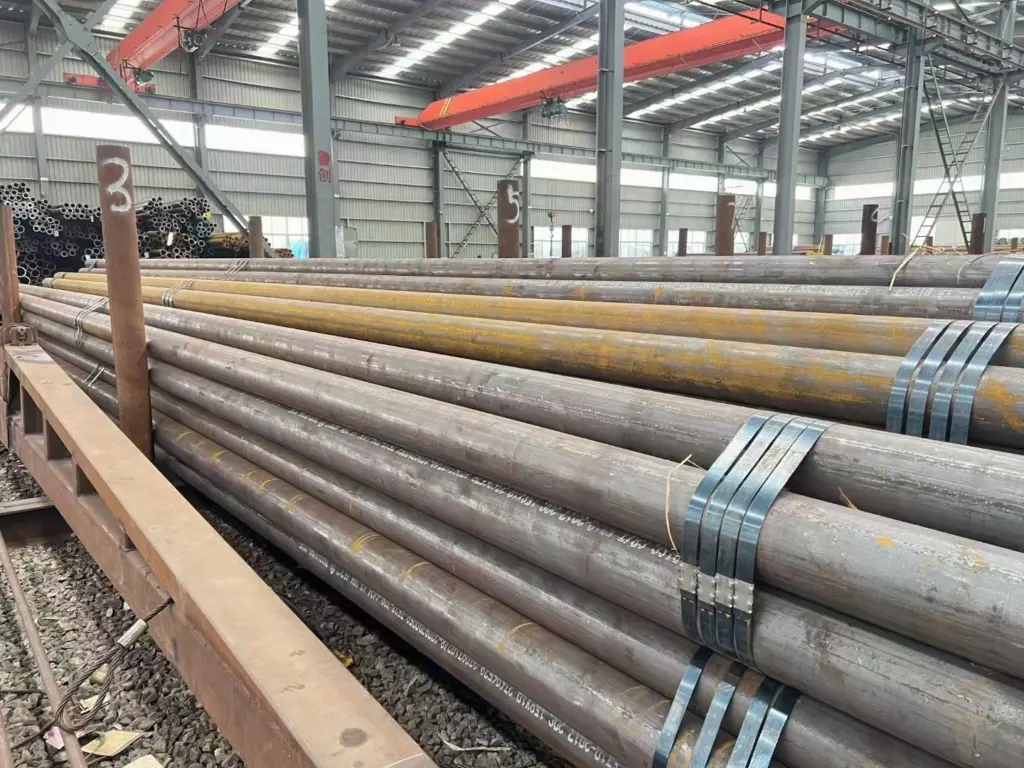
JIS G3445 STKM Carbon Steel Seamless Pipe for Machine Structural Purposes
November 12, 2025
Heavy Wall Thickness SCH 160 Seamless Steel Pipe
November 28, 2025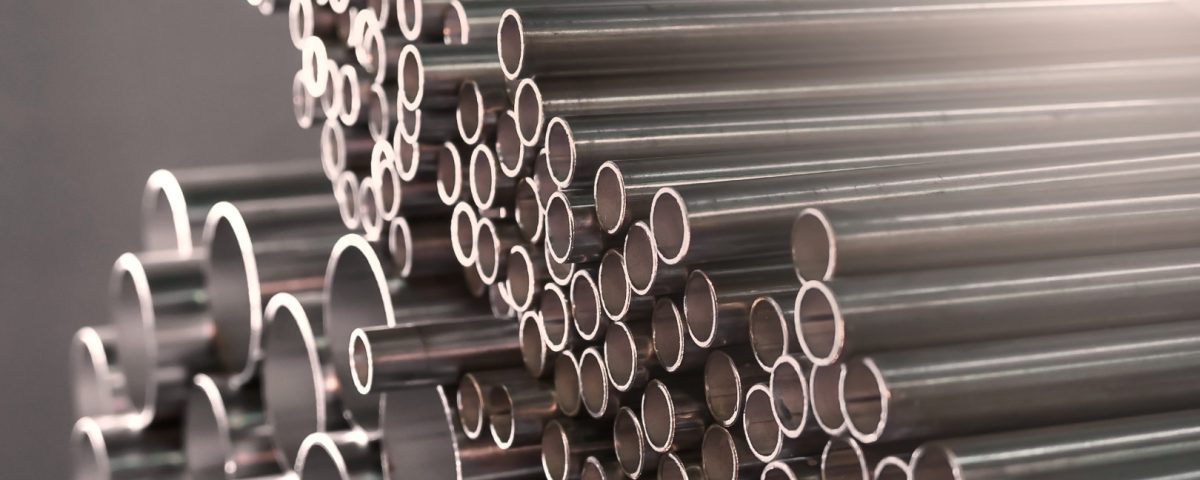
The Architecture of Accuracy: Exploring the EN 10305 Welded Cold Drawn Precision Steel Pipe
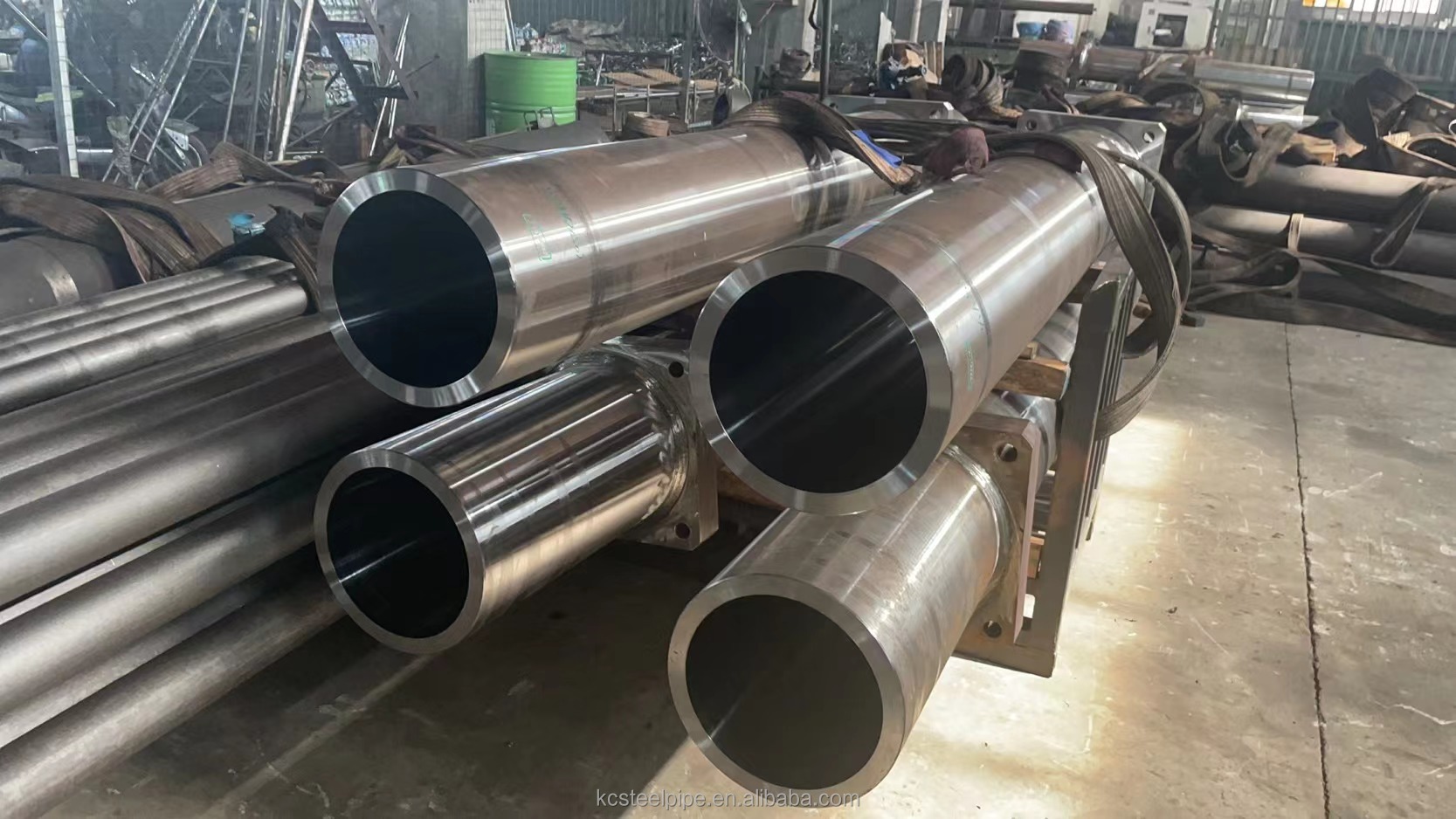
The modern engineering world, characterized by highly automated systems, compact designs, and exacting performance requirements, demands materials that adhere to stringent dimensional and mechanical standards. Within this sphere, the EN 10305 series of European standards for steel tubes stands out, specifically defining the requirements for Cold Drawn Welded Precision Steel Pipe. This material is not a simple commodity; it is a meticulously manufactured component designed to integrate seamlessly into complex mechanical systems, hydraulic circuits, and high-precision structural frameworks. It represents a confluence of robust welding technology and the transformative power of cold drawing, yielding tubes whose integrity is defined not by bulk, but by accuracy.
This exploration delves into the intricacies of EN 10305, focusing on the common grades E215, E235, and E335. It is a journey from the raw steel coil, through the high-frequency electric resistance welding (ERW) process, and into the precise, stress-relieving world of cold drawing. We seek to understand the underlying philosophy of the European standard—a commitment to uniform quality and predictable performance—and how the specified grades and crucial delivery conditions allow engineers to tailor the material’s properties precisely to the task at hand, whether that task demands high formability or high strength.
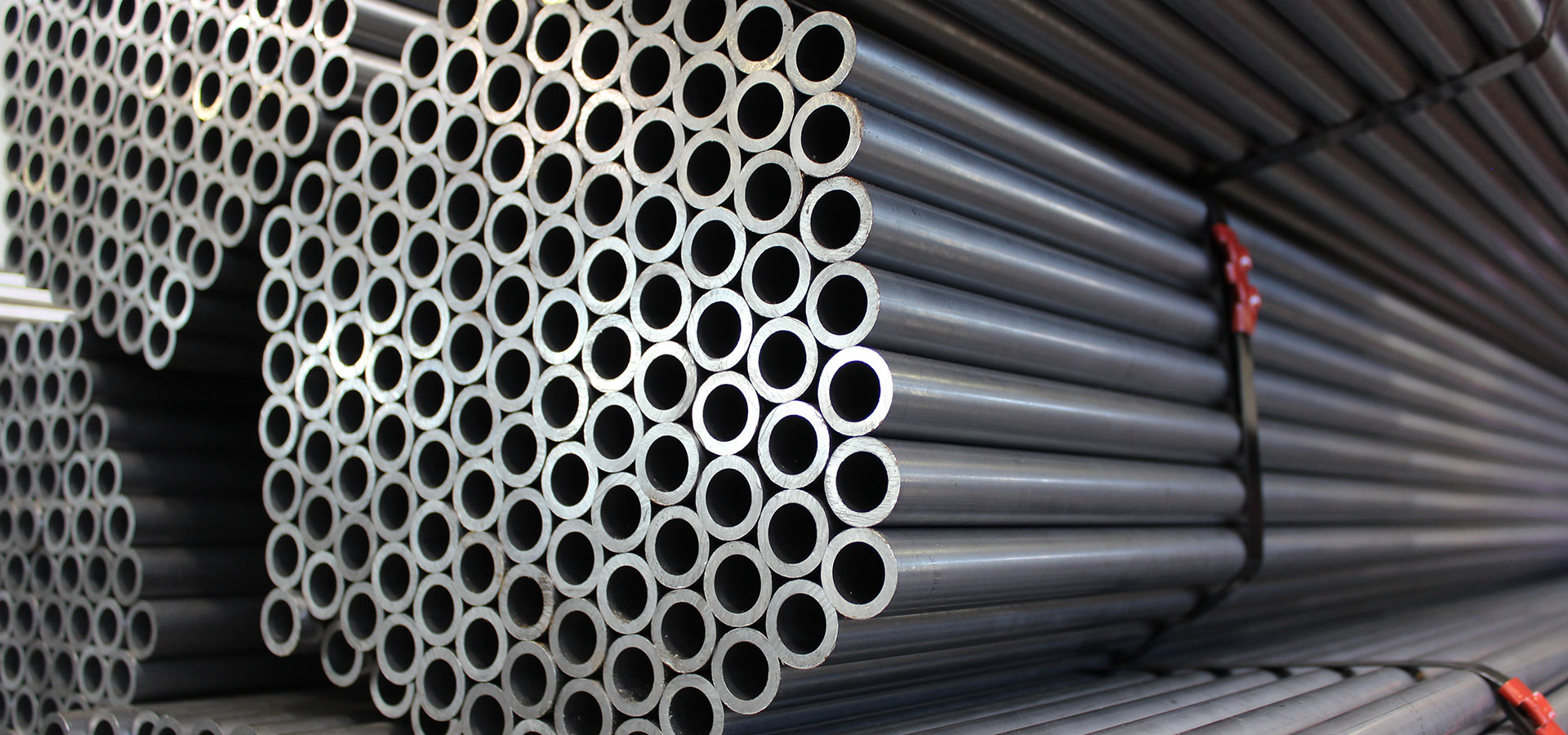
1. The Necessity of Precision: Defining EN 10305 and the Cold Drawn Mandate
The European Standard EN 10305 is titled “Steel Tubes for Precision Applications,” and the word “precision” is the key to understanding its scope and value proposition. These tubes are destined for roles where dimensional deviation is unacceptable: components in automotive steering columns, shock absorber bodies, high-tolerance mechanical shafts, or the internal tubes of hydraulic cylinders where the consistent gap between the tube and the piston is vital for sealing and performance.
The tubes manufactured under this standard are typically Welded, beginning their life as a flat steel strip (coil). This is a critical point of difference from seamless tubing. While seamless tubing offers superior homogeneity and burst strength for extremely high-pressure containment, the initial advantage of welded tubing lies in its exceptional consistency of wall thickness (WT). Because the tube starts as a precision-slit steel strip of uniform thickness, the resulting welded tube inherently exhibits much lower eccentricity (the difference between max and min wall thickness) than a seamless tube formed from a solid billet. This uniformity is paramount for components requiring balance or consistent section modulus.
However, the tube’s journey from a raw welded state to a precision component hinges entirely upon the subsequent process: Cold Drawing.

The Transformative Power of Cold Drawing
Cold drawing is a mechanical finishing operation performed at ambient temperature, forcing the tube through a die and over an internal mandrel (or plug). This action achieves three critical outcomes simultaneously:
- Dimensional Refinement: The tube is physically sized, reducing its outer diameter (OD) and inner diameter (ID), drastically tightening the tolerance on both dimensions, often down to $\pm 0.1 \text{ mm}$ or less. This is the source of the “precision” designation.
- Surface Enhancement: The cold drawing operation burnishes the surface, improving both the external and internal surface finishes (lower $R_a$ values). A smooth internal bore is vital for seal wear and fluid flow, while a smooth external surface is necessary for coating and appearance.
- Mechanical Property Modification (Work Hardening): The severe plastic deformation introduces residual stresses and refines the steel’s grain structure, significantly increasing the Yield Strength ($R_{eH}$) and Tensile Strength ($R_m$), albeit at the expense of ductility (Elongation $A$).
The integration of quality welding with the rigorous cold-drawing process allows EN 10305 tubes to deliver a combination that is difficult to achieve with other methods: excellent wall uniformity, extremely tight dimensional accuracy, and tailored mechanical properties.
2. The Metallurgical Blueprint: Grades E215, E235, and E335
The core of the EN 10305 standard rests on three principal material grades, which are designated based on their minimum guaranteed Yield Strength ($R_{eH}$): E215, E235, and E335. These are carbon steels whose properties are meticulously controlled by adjusting the Carbon (C) and Manganese (Mn) content. The prefix ‘E’ indicates an Engineering Steel, suitable for mechanical and structural applications.
The manufacturer’s adherence to the chemical limits is non-negotiable, particularly the tight control over impurities like Phosphorus (P) and Sulfur (S). High levels of these elements severely impair weld integrity, ductility, and machinability—qualities essential for precision tubing.
The Role of Specific Grades: A Gradient of Strength
- E215 ($\text{min } R_{eH} \approx 215 \text{ N/mm}^2$): This grade possesses the lowest carbon content and highest inherent ductility. It is chosen when the application requires severe cold forming, bending, flaring, or manipulation after the initial cold drawing process. It offers the best compromise for formability over raw strength.
- E235 ($\text{min } R_{eH} \approx 235 \text{ N/mm}^2$): The workhorse of the EN 10305 standard. E235 offers an optimal balance between moderate strength, good weldability, and sufficient ductility for typical forming operations. It is the most frequently specified grade for general mechanical engineering, structural framework, and automotive components.
- E335 ($\text{min } R_{eH} \approx 335 \text{ N/mm}^2$): This grade utilizes a higher carbon and manganese content to achieve a significantly higher yield strength. It is used when higher static or dynamic loads must be borne, or when a lower wall thickness is required for weight saving without compromising structural integrity. Its increased strength means its formability and weldability are comparatively reduced, requiring more care during processing.
The table below summarizes the typical chemical composition requirements for the selected grades, noting that the standard allows for slight variance in Mn and C content depending on the thickness and agreed-upon manufacturing process, provided the mechanical properties are met.
| Material Grade | C (max %) | Si (max %) | Mn (max %) | P (max %) | S (max %) | Cu (max %) |
| E215 | 0.10 | 0.35 | 0.70 | 0.025 | 0.025 | 0.25 |
| E235 | 0.17 | 0.35 | 1.20 | 0.025 | 0.025 | 0.25 |
| E335 | 0.20 | 0.35 | 1.50 | 0.025 | 0.025 | 0.25 |
The tight maximum limits on P and S ($\mathbf{0.025\%}$) are particularly indicative of the material’s precision status, ensuring excellent surface quality, internal structure, and minimal risk of cracking during cold working or subsequent bending operations.
3. The Definition of Performance: Tensile Requirements and Delivery Conditions
For EN 10305, specifying the chemical grade (E235) is only half the picture. The other crucial element is the Delivery Condition, which dictates the final heat treatment state and, consequently, the actual mechanical properties, particularly the resulting Yield and Tensile Strength after the cold drawing process. The cold drawing process itself significantly hardens the steel (work hardening), but this hardness can be partially or fully reversed through controlled heat treatment.
The Five Crucial Delivery Conditions
The EN 10305 standard specifies five main delivery conditions, often designated by a suffix preceded by a plus sign (+):
- +C (Cold Drawn/Hard): The tube is finished by cold drawing without any subsequent heat treatment. It retains the maximum effect of work hardening.
- Properties: Highest Yield Strength, Highest Tensile Strength, Lowest Ductility (Hardest Condition), Highest Internal Residual Stress.
- Application: Structural parts where maximum stiffness/strength is required, and no further forming is intended.
- +LC (Cold Drawn/Soft): The tube is cold drawn followed by a light controlled annealing process.
- Properties: Moderate strength, improved ductility compared to +C, lower internal stress.
- Application: Parts requiring some bending or simple forming after delivery.
- +SR (Stress Relieved): The tube is cold drawn and then subjected to a low-temperature stress relief annealing (e.g., $450^{\circ}\text{C}$ to $600^{\circ}\text{C}$).
- Properties: High strength is largely maintained, but internal stresses are significantly reduced.
- Application: Ideal for parts that require high strength but must be dimensionally stable after cutting or light machining (e.g., precision shafts, parts subject to vibration).
- +A (Annealed): The tube is cold drawn and then fully annealed (heated above the upper critical temperature and cooled slowly).
- Properties: Lowest strength, highest ductility (Softest Condition), minimal residual stress.
- Application: Parts requiring severe cold forming, flaring, or bending (e.g., complex hydraulic lines, automotive manifolds).
- +N (Normalized): The tube is cold drawn and then normalized (heated above the upper critical temperature and cooled in still air).
- Properties: Intermediate strength and ductility, refined grain size, good impact toughness.
- Application: Components requiring a uniform, highly predictable microstructure for critical structural applications.
The required mechanical properties are therefore a function of the grade AND the delivery condition. The following table illustrates the minimum tensile requirements for the common E235 grade across the different delivery conditions, showcasing the enormous variation possible from the same base steel:
| Grade | Delivery Condition | Minimum Yield Strength (N/mm2) | Minimum Tensile Strength (N/mm2) | Min Elongation (%) |
| E235 | +C (Hard) | 350 | 480 | 6 |
| E235 | +LC (Soft Drawn) | 280 | 420 | 10 |
| E235 | +SR (Stress Relieved) | 315 | 450 | 8 |
| E235 | +A (Annealed) | 235 | 360 | 25 |
| E235 | +N (Normalized) | 235 | 360 | 25 |
The engineer must specify the precise combination, recognizing that a tube in the +C condition has far higher strength but will be difficult or impossible to bend without cracking, whereas the +A condition offers superb flexibility for forming but provides minimal resistance to yielding under load. This multi-layered specification system is what truly defines EN 10305 as a precision standard—the properties are not accidental; they are precisely engineered.
4. Dimensional Integrity: Tolerances of Thickness Schedules and Dimensions
The essence of the “precision” designation lies in the tight dimensional tolerances achieved by the cold drawing process. For EN 10305 tubes, the control over the outer diameter (OD), inner diameter (ID), and, crucially, the wall thickness (WT) is significantly tighter than general-purpose structural or pressure piping.
Tolerance of Thickness Schedules and Concentricity
As mentioned, a key advantage of welded tube is the low eccentricity resulting from using uniform steel strip. The cold drawing process further enhances this uniformity. The tolerances specified for wall thickness (WT) are typically applied to the nominal dimension and vary depending on the ratio of OD to WT, but they are consistently demanding.
| Parameter | Standard Tolerance (General Guidelines) | Engineering Significance |
| Outer Diameter (OD) | $\pm 0.1 \text{ mm}$ (for smaller OD) to $\pm 0.3 \text{ mm}$ (for larger OD) | Critical for proper fitment into bearings, clamps, and external couplings (e.g., automotive shafts). |
| Inner Diameter (ID) | $\pm 0.1 \text{ mm}$ (or tighter for honed ID) | Essential for pneumatic/hydraulic piston sealing and uniform fluid flow. |
| Wall Thickness (WT) / Thickness Schedule | $\pm 10\%$ but often $\pm 0.1 \text{ mm}$ (for thinner walls) | Guarantees consistent section modulus and balance; minimal fluctuation in weight per meter; crucial for high-speed rotating shafts. |
| Eccentricity (Wall Thickness Variation) | Typically limited to $\leq 10\%$ of nominal WT. | Ensures high concentricity and predictable stress distribution around the tube circumference. |
| Straightness | Max deviation of 1/1000 to 1/1500 of the tube length. | Necessary for linear guides, shafts, and other components requiring high alignment to prevent vibration and jamming. |
The commitment to such tight tolerances is a significant manufacturing challenge, demanding high-precision tooling (dies and mandrels), superior lubrication, and rigorous quality control throughout the cold drawing process. For example, in a hydraulic shock absorber, the wall thickness directly dictates the volume and pressure capacity of the fluid chamber. A variation of even $0.2 \text{ mm}$ in WT could compromise the performance envelope or require costly compensatory machining. The use of EN 10305 minimizes the need for such secondary machining, as the as-drawn tube often meets the required final dimensions.
5. Features and Applications: Where Precision Drives Performance
The combination of the base grades (E215, E235, E335) and the specified delivery conditions (+C, +SR, +A, +N) results in tubes with a suite of features uniquely suited for mechanical applications.
Key Features of EN 10305 Precision Tubes
| Feature Category | Descriptive Feature | Functional Advantage |
| Geometric Excellence | Tight Dimensional Tolerances | Minimal need for post-processing; reduced machining costs; high component interchangeability. |
| Mechanical Reliability | Tailored Mechanical Properties | Properties (Strength/Ductility) are guaranteed based on the specified delivery condition, enabling optimal structural design. |
| Surface Quality | Smooth Internal/External Finish | Reduced friction (internal); ideal for direct plating/coating (external); better aesthetic finish. |
| Manufacturing Consistency | Superior Wall Uniformity (Low Eccentricity) | Ensures structural balance, uniform heat transfer, and predictable load distribution in shafts and cylinders. |
| Weld Integrity | Controlled Weld Seam | The ERW weld is normalized during cold drawing and is often invisible to NDT, ensuring structural continuity. |
Critical Applications
The EN 10305 precision steel pipe is the default choice for numerous high-demand industrial sectors:
- Automotive Industry: Used extensively for seating mechanisms, safety cage structures, steering column shafts, brake lines (small OD), engine mounts, and suspension components (e.g., stabilizer bars, shock absorber sleeves). The ability to use a high-strength grade (E335 +SR) allows for lightweighting initiatives without sacrificing safety.
- Hydraulics and Pneumatics: Used for low-to-medium pressure hydraulic lines and, critically, for non-honed cylinder barrels where the as-drawn ID finish is sufficient, often utilizing E235 +C or +SR for strength.
- General Machinery and Robotics: Linear guide rails, precision shafts, telescopic arms in automation systems, and rollers in high-speed conveying equipment where concentricity and straightness are vital for smooth operation and longevity.
- Furniture and Display: High-end, chrome-plated furniture and display racks utilize the excellent surface finish and dimensional consistency for aesthetic quality and ease of assembly.
6. Manufacturing Rigor and Quality Assurance: Guaranteeing the Weld
The manufacturing process for EN 10305 welded tubes is a meticulous choreography of transformation, where quality control is an integrated function, not an afterthought. The integrity of the weld seam, in particular, must be proven beyond doubt, as it becomes an integral, load-bearing feature of the finished product.
The Welding Process and Weld Seam Control
The tubes are typically produced via High-Frequency Electric Resistance Welding (HFERW). In this process, the edges of the formed strip are heated rapidly to the plastic state via high-frequency current, and then immediately pressed together to create a solid-state weld.
The rigorous control involves:
- Non-Destructive Testing (NDT): Every meter of the welded seam is typically subjected to continuous NDT, often using Eddy Current Testing or Ultrasonic Testing, to detect any microscopic lack of fusion, porosity, or inclusions immediately after welding and before the cold drawing. This ensures that only sound material proceeds to the costly cold finishing stage.
- Destructive Testing: Regular physical tests, such as the Flange Test or the Flattening Test, are performed. These tests subject the weld seam to extreme stresses (forcing the seam to either expand or compress) to prove that the weld zone is as strong and ductile as the parent material.
The subsequent Cold Drawing process subjects the weld seam to a significant plastic deformation test. The material deformation during drawing further refines the grain structure of the weld zone, often making the weld line metallurgically and structurally indistinguishable from the surrounding material, provided the initial weld was flawless. The specification of the delivery condition, particularly +N (Normalized), aims to fully homogenize the weld and heat-affected zone (HAZ) with the parent metal, guaranteeing uniform properties across the tube body.
Conclusion: The Uncompromised Quality of EN 10305
The EN 10305 (E215, E235, E335) Cold Drawn Welded Precision Steel Pipe is a hallmark of modern material specification, embodying the principle that accuracy is the foundation of reliability. The standard provides a comprehensive, multi-faceted specification system that allows engineers to precisely dictate the tube’s geometry and mechanical response.
The starting point—the uniform wall thickness derived from the coil—is preserved and enhanced through the controlled violence of the cold drawing process. This process, coupled with the critical designation of the Delivery Condition (+C, +SR, +A, +N), allows for the creation of components that are not merely strong, but intelligently strong: strong when needed (E335 +C), ductile when needed (E215 +A), and dimensionally stable when needed (E235 +SR).
The material’s enduring presence in high-stakes industries, from automotive safety systems to precise robotic mechanisms, is a testament to the rigorous quality assurance of the European Standard. It guarantees minimal eccentricity, superior surface finish, and mechanical properties tailored to the application. The EN 10305 tube is an elegant solution to complex engineering challenges, ensuring that the components that rely upon it will perform with the precision and predictability essential for the success of advanced industrial design.